
Blog
How Many Units is 2.5 mg of Tirzepatide?
Mar
Understanding how many units equal 2.5 mg of tirzepatide is one of the most common questions people ask when working with peptide solutions. At first glance, it seems like a simple conversion. However, the real answer depends entirely on how the peptide was reconstituted. In other words, the number of units is not fixed. Instead, it changes based on the amount of bacteriostatic water added to the vial.
This guide from Core Peptides explains the concept in simple, practical terms. You will learn how units relate to milligrams, why reconstitution matters, and how to calculate your volume correctly. This content is educational only and not medical advice.
The Simple Truth: Units Depend on Your Reconstitution
To begin with, you need to understand the difference between milligrams and units.
Milligrams (mg) measure weight. Units measure volume on an insulin syringe. Therefore, you cannot convert mg to units without knowing the concentration of your solution.
Think of it like making juice. If you mix one packet of juice with one glass of water, the flavor is strong. However, if you mix the same packet with two glasses of water, the flavor becomes weaker. The packet did not change. Only the concentration changed.
Peptides work the same way.
A quick story to make this clear
Consider Daniel, who had a 10 mg vial of tirzepatide. He added 1 mL of bacteriostatic water. Later, his friend added 2 mL of water to the same size vial.
Both had 10 mg total. However, Daniel’s solution was twice as concentrated.
As a result, Daniel needed fewer units to reach 2.5 mg, while his friend needed more units.
Neither was wrong. They simply had different concentrations.
This is why there is no universal unit number without context.
Understanding insulin syringe units
Most peptide users work with U-100 insulin syringes. These syringes have 100 units per 1 mL.
This means:
10 units = 0.10 mL
20 units = 0.20 mL
25 units = 0.25 mL
50 units = 0.50 mL
100 units = 1.00 mL
Units measure liquid volume, not peptide weight.
Therefore, the peptide concentration determines how many units you need.
Example 1: 10 mg vial mixed with 1 mL
This is one of the most common setups.
Total peptide: 10 mg
Total liquid: 1 mL
Concentration: 10 mg per mL
Now divide into units.
Since 1 mL = 100 units
Each 10 units = 1 mg
Therefore:
2.5 mg = 25 units
In this scenario, 2.5 mg equals 25 units.
Example 2: 10 mg vial mixed with 2 mL
Now the peptide is more diluted.
Total peptide: 10 mg
Total liquid: 2 mL
Concentration: 5 mg per mL
Since 2 mL = 200 units
Each 20 units = 1 mg
Therefore:
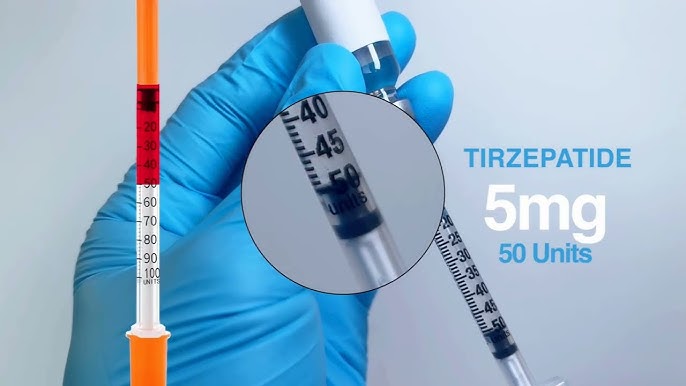
2.5 mg = 50 units
Same peptide amount. Different unit number.
Example 3: 10 mg vial mixed with 4 mL
This creates an even weaker concentration.
Total peptide: 10 mg
Total liquid: 4 mL
Concentration: 2.5 mg per mL
Each 40 units = 1 mg
Therefore:
2.5 mg = 100 units
Again, the milligrams did not change. Only the volume changed.
Why many people prefer the 1 mL method
Many users choose to mix 10 mg with 1 mL because the math becomes easier.
For example:
1 mg = 10 units
2 mg = 20 units
2.5 mg = 25 units
5 mg = 50 units
This simplicity reduces calculation errors.
However, others prefer more dilution for smoother measuring.
Both approaches work when calculated properly.
Why accuracy matters
Accuracy improves consistency, confidence, and workflow.
When your calculations are correct:
You avoid wasting product
You maintain predictable measurements
You reduce confusion
You improve organization
Most importantly, you eliminate guessing.
How to calculate any dose yourself
Fortunately, the formula is simple.
Step 1: Know total mg in vial
Step 2: Know total mL added
Step 3: Divide mg by mL
Step 4: Convert mL to units
Example formula
mg per mL = total mg ÷ total mL
units needed = desired mg ÷ mg per unit
With practice, this becomes automatic.
Why Core Peptides recommends planning your mix
Core Peptides emphasizes structured preparation because it simplifies everything later.
When you mix intentionally, you create predictable conversions.
As a result:
Measuring becomes easier
Storage becomes organized
Tracking becomes simpler
In contrast, random mixing creates confusion.
Common mistake: confusing units with milligrams
This is the most frequent beginner error.
Units are not dosage. Units are volume.
The dosage is determined by concentration.
Always remember this distinction.
Another story: How organization prevented mistakes
Marcus kept a small notebook beside his peptide kit.
Every time he reconstituted a vial, he wrote:
Date
Total mg
Total mL
Units per mg
Because of this habit, he never had to guess later.
His system saved time and reduced stress.
Simple habits create long-term clarity.
How reconstitution affects unit conversion long term
Consistency is key.
When you use the same mixing ratio every time:
Your calculations remain identical
Your workflow becomes faster
Your confidence improves
Therefore, many experienced users standardize their ratios.
How storage connects to accurate dosing
Proper storage protects concentration integrity.
When stored correctly:
Evaporation is minimized
Contamination risk is reduced
Solution stability improves
As a result, your calculations remain valid.
Disorganized storage, however, increases uncertainty.
Visualizing concentration another way
Imagine two identical bottles of coffee.
Bottle A contains 1 spoon of coffee in 1 cup of water.
Bottle B contains 1 spoon of coffee in 4 cups of water.
Both contain the same coffee amount.
However, one requires drinking more liquid to get the same strength.
This is exactly how peptide concentration works.
Predictability builds confidence.
When you know your numbers:
Preparation becomes faster
Measurement becomes easier
Tracking becomes cleaner
Consequently, everything feels more professional.
How Core Peptides supports structured preparation
Core Peptides focuses on providing high-quality lyophilized peptides that are stable, consistent, and reliable.
Because consistency begins at the source, structured preparation becomes easier.
As a result, users can focus on organization instead of uncertainty.
Key takeaway summary
Here is the most important point:
2.5 mg does not equal a fixed number of units.
Instead, the units depend entirely on your reconstitution.
However, in the most common example:
10 mg mixed with 1 mL = 2.5 mg equals 25 units
Other mixing ratios will produce different unit numbers.
Therefore, always calculate based on your specific setup.
Final thoughts
Learning how units relate to milligrams is a foundational skill when working with peptides.
At first, it may seem confusing. However, once you understand concentration, everything becomes logical.
Organization, consistency, and preparation make the process simple.
Core Peptides encourages education, structure, and clarity so users can maintain predictable workflows and confident handling.

