
Blog
Peptide mixing chart
Feb
Peptide Mixing Chart: Complete Reconstitution Guide with Dosage Calculator (2026)
A peptide mixing chart shows how much bacteriostatic water to add to a peptide vial and how many syringe units equal specific doses. Most 5mg peptides are mixed with 2ml of water, making 250mcg equal 10 insulin syringe units.
A peptide mixing chart shows how much bacteriostatic water to add to a peptide vial and how to measure accurate doses using an insulin syringe.
The goal is to create a concentration that allows precise and easy measurement.
Peptide Mixing Chart (5mg, 10mg, and 15mg Vials)
5mg Peptide Mixing Chart
| Bacteriostatic Water Added | Peptide Concentration | 250mcg Dose | 500mcg Dose |
|---|---|---|---|
| 1 ml | 5000 mcg/ml | 5 units | 10 units |
| 2 ml | 2500 mcg/ml | 10 units | 20 units |
| 3 ml | 1666 mcg/ml | 15 units | 30 units |
10mg Peptide Mixing Chart
| Water Added | Concentration | 250mcg Dose | 500mcg Dose |
|---|---|---|---|
| 1 ml | 10000 mcg/ml | 2.5 units | 5 units |
| 2 ml | 5000 mcg/ml | 5 units | 10 units |
| 3 ml | 3333 mcg/ml | 7.5 units | 15 units |
15mg Peptide Mixing Chart
| Water Added | Concentration | 250mcg Dose | 500mcg Dose |
|---|---|---|---|
| 1 ml | 15000 mcg/ml | 1.6 units | 3.3 units |
| 2 ml | 7500 mcg/ml | 3.3 units | 6.6 units |
| 3 ml | 5000 mcg/ml | 5 units | 10 units |
What You Need for Peptide Mixing
Before reconstitution, prepare:
-
Peptide vial
-
Bacteriostatic water
-
Insulin syringes
-
Alcohol swabs
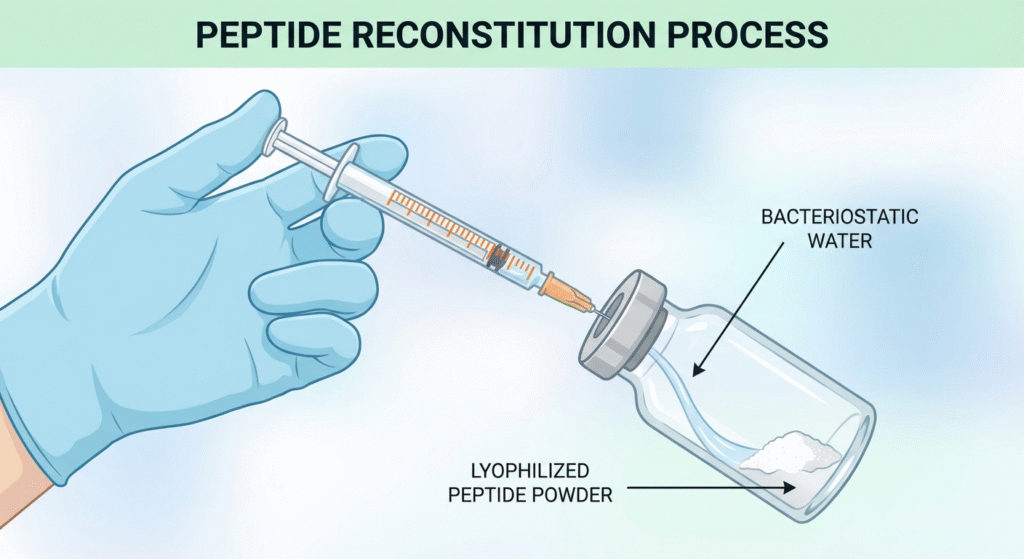
Step-by-Step Peptide Mixing Instructions
Step 1: Clean the Vials
Wipe both vials with alcohol swabs.
Step 2: Draw Bacteriostatic Water
Pull desired amount into syringe.
Example:
-
2ml is most common mixing amount
Step 3: Inject Water Slowly
Inject slowly down the vial wall.
Avoid shaking.
Step 4: Let Peptide Dissolve
Let vial sit until fully clear.
Do NOT shake aggressively.
Why Most People Use 2ml Mixing Ratio
Adding 2ml provides:
-
Easy dose calculation
-
Accurate measurements
-
Less dosing mistakes
Example:
10mg peptide + 2ml water =
5000mcg per ml
250mcg dose = 5 units
Insulin Syringe Units Explained
Standard insulin syringe:
| Units | Volume |
|---|---|
| 10 units | 0.1 ml |
| 20 units | 0.2 ml |
| 50 units | 0.5 ml |
| 100 units | 1 ml |
Most Common Peptides and Typical Mixing Amounts
| Peptide | Common Vial Size | Typical Water Added |
|---|---|---|
| Semaglutide | 5mg | 2ml |
| Tirzepatide | 10mg | 2ml |
| CJC-1295 | 5mg | 2ml |
| Ipamorelin | 5mg | 2ml |
| BPC-157 | 5mg | 2ml |
| TB-500 | 10mg | 2ml |
Example: Semaglutide Mixing Example
5mg vial + 2ml water
Result:
2500mcg per ml
If dose needed = 250mcg
You inject:
10 units
Example: Tirzepatide Mixing Example
10mg vial + 2ml water
Result:
5000mcg per ml
500mcg dose =
10 units
Storage After Mixing
Store in refrigerator:
Temperature:
2°C to 8°C
Shelf life:
-
30–60 days refrigerated
Never freeze after mixing.
Common Peptide Mixing Mistakes
Avoid:
Shaking vial aggressively
Adding wrong water amount
Using tap water
Storing at room temperature
Peptide Mixing Formula (Simple Calculator)
Formula:
Peptide amount ÷ Water added = Concentration
Then:
Dose ÷ Concentration = Injection volume
Example:
5mg peptide
2ml water
Result:
2500mcg/ml
Why Accurate Mixing Is Important
Proper mixing ensures:
Accurate dosing
Consistent results
Reduced waste
Incorrect mixing causes:
Overdosing
Underdosing
Poor results
Frequently Asked Questions
What is the best amount of water to mix peptides?
2ml is the most common and easiest ratio.
Can you mix peptides with sterile water?
Bacteriostatic water is preferred because it lasts longer.
How long do mixed peptides last?
Typically 30–60 days refrigerated.
Can you mix multiple peptides in one syringe?
Some research protocols combine peptides, but mixing should follow compatibility guidelines.