
Blog
Retatrutide vs Semaglutide: Which Peptide Is More Advanced ?
Apr
Retatrutide vs Semaglutide: Which Peptide Is More Advanced in 2026?
Understanding the Distinction Between Retatrutide and Semaglutide
In the evolving world of metabolic peptide research, Retatrutide and Semaglutide often come up in direct comparison discussions. Both compounds are GLP-1 receptor agonists, yet they occupy very different positions in the research landscape.
Semaglutide has been widely studied and discussed for several years. It is primarily known for its effects on appetite regulation, glucose metabolism, and weight management. Retatrutide, on the other hand, is considered a next-generation investigational compound with a broader signaling profile. In research discussions, it is often described as a triple agonist, interacting with GLP-1, GIP, and glucagon receptors. This multi-pathway activity differentiates Retatrutide from the older, single-pathway focus of Semaglutide.
The key question researchers often ask is: Does Retatrutide’s expanded receptor profile make it more advanced for metabolic research than Semaglutide, and if so, in what contexts?
Why Comparisons Matter
Comparisons between Retatrutide and Semaglutide are not merely academic. They reflect an interest in understanding:
- Appetite vs broader metabolic control
- Body composition signaling pathways
- Research applications for layered metabolic investigations
- The potential of next-generation compounds relative to established ones
This discussion is essential for those who are already familiar with peptide research and want to understand the nuances of new compounds.
The Mechanistic Differences Between Retatrutide and Semaglutide
GLP-1 Pathway Focus
Both Retatrutide and Semaglutide act on the GLP-1 receptor, which is primarily associated with appetite suppression and glucose metabolism regulation. Semaglutide has a well-established GLP-1 agonist profile, making it a staple reference compound in many research studies.
Retatrutide, however, does more than GLP-1 activation. While it retains potent GLP-1 receptor agonism, it also engages GIP and glucagon receptors, providing a broader metabolic signal. In research discussions, this triple-agonist behavior is often highlighted as a potential advantage for studies targeting:
- Multi-pathway appetite regulation
- Fat oxidation
- Energy expenditure
- Broader metabolic flexibility
The triple receptor engagement is what often leads researchers to describe Retatrutide as “next-generation.”
Appetite vs Multi-Pathway Signaling
In many research circles, Semaglutide is still the gold standard for single-pathway appetite modulation, whereas Retatrutide is considered more exploratory in nature, with discussions often centering around layered metabolic effects. This distinction is critical when evaluating the relative research “advancement” of the two compounds.
Body Composition and Metabolic Research Applications
Semaglutide: The Appetite-Focused Compound
Semaglutide is frequently discussed in studies examining:
- Weight management
- Appetite control
- Glucose regulation
- Basic fat-loss models
Its research applications tend to be well-documented and more predictable due to years of data accumulation. Semaglutide is often used as a reference compound in comparative studies, particularly when new peptides like Retatrutide are introduced.
Retatrutide: Expanding the Research Scope
Retatrutide, in contrast, is frequently described in discussions of broader metabolic and body-composition research. Its triple-agonist profile allows researchers to explore:
- Multi-pathway energy balance
- Advanced fat-loss modeling
- Layered metabolic responses
- Potential synergistic receptor effects
This is why many peptide researchers now view Retatrutide as the “advanced” compound, particularly for studies that are beyond appetite regulation alone.
Efficacy Considerations in Comparative Research
When researchers compare Retatrutide and Semaglutide, efficacy discussions usually focus on:
- Appetite suppression
- Semaglutide is well-established; Retatrutide shows similar appetite suppression but may have added benefits due to receptor breadth.
- Energy expenditure
- Retatrutide’s glucagon receptor engagement may influence energy metabolism in ways Semaglutide does not, making it more appealing for multi-pathway studies.
- Fat distribution
- Retatrutide’s broader receptor activity often comes up in discussions around fat loss distribution and advanced body-composition research models.
- Multi-compound research potential
- Semaglutide is usually studied alone or with minor adjuncts; Retatrutide is increasingly discussed in stacks with other peptides like Cagrilintide or AOD-9604 for layered research purposes.
Why Some Researchers Still Reference Semaglutide
Even as Retatrutide grows in attention, Semaglutide remains a benchmark due to:
- Long-term safety and efficacy data in human studies
- Well-understood pharmacokinetics
- Broad familiarity in metabolic research communities
Retatrutide discussions often frame Semaglutide as the “baseline,” with Retatrutide positioned as the experimental advancement.
Comparative Research Use-Cases
Standalone Studies
- Semaglutide: Often used as a standalone reference in appetite and weight management studies.
- Retatrutide: Can be studied standalone, but its potential often shines in multi-pathway research models.
Stacking and Multi-Peptide Protocols
Retatrutide is frequently discussed in combination with other peptides for advanced research applications:
- Retatrutide + Cagrilintide: Appetite-focused plus metabolic breadth
- Retatrutide + AOD-9604: Body composition focus
- Retatrutide + Tesamorelin: Advanced energy and metabolic signaling
- Retatrutide + MOTS-c: Emerging mitochondrial and metabolic efficiency research
These discussions are rarely mirrored for Semaglutide because its single-pathway action is already well understood.
Contextual Relevance
The decision to explore Retatrutide versus Semaglutide often depends on research objectives:
- Appetite regulation only → Semaglutide
- Multi-pathway energy and fat-loss research → Retatrutide
- Advanced metabolic modeling → Retatrutide stacks
Pharmacokinetics and Receptor Engagement
Half-Life and Duration of Action
- Semaglutide: Long-acting GLP-1 agonist, widely studied for steady-state appetite modulation.
- Retatrutide: Triple-agonist profile may result in more complex receptor kinetics, which is an active discussion point in research communities.
Receptor Selectivity
- Semaglutide: Highly selective for GLP-1
Potential Advantages of Retatrutide in 2026
- Broader metabolic impact
Multi-receptor engagement opens additional research avenues beyond appetite regulation. - Advanced fat-loss modeling
Some research discussions highlight Retatrutide’s potential in layered body-composition experiments. - Stacking versatility
Retatrutide can theoretically be combined with other peptides to investigate multi-pathway effects. - Novel research applications
Emerging interest in mitochondrial and energy-efficiency studies favors Retatrutide due to receptor diversity.
Limitations and Considerations
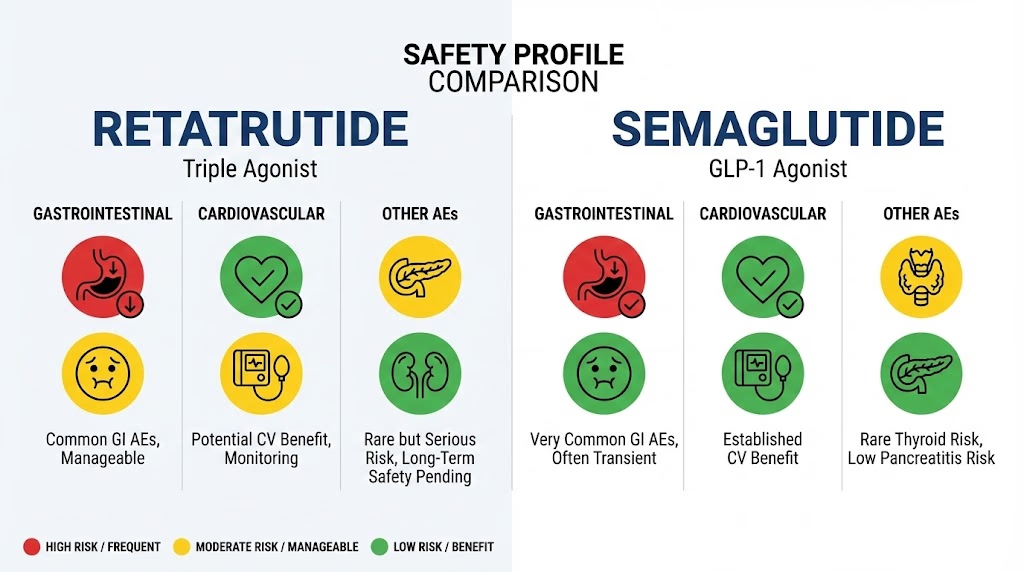
- Less human data
Retatrutide is investigational; long-term human studies are limited. - Complexity of research protocols
Multi-pathway signaling requires careful study design to isolate effects. - Safety and stability considerations
Investigational compounds demand attention to proper handling, storage, and study conditions. - Regulatory status
Retatrutide is not approved for clinical use; it remains strictly for research applications.
When Semaglutide May Still Be Preferred in Research
Furthermore, Retatrutide is often described as “more advanced,” Semaglutide remains relevant for:
- baseline reference studies
- appetite-focused investigations
- simpler research protocols
- comparative efficacy studies
Its well-characterized profile makes it an ideal standard when new compounds like Retatrutide are introduced.
Summary of Key Differences
| Feature | Semaglutide | Retatrutide |
|---|---|---|
| Receptor profile | GLP-1 only | GLP-1, GIP, Glucagon |
| Appetite suppression | Established | Comparable |
| Multi-pathway effects | Limited | Expanded |
| Fat-loss modeling | Moderate | Advanced |
| Stacking potential | Limited | High |
| Research novelty | Established | Emerging |
This table captures the main distinctions most researchers discuss when comparing the two compounds.
Our Concluding Thoughts
In 2026, the discussion between Retatrutide and Semaglutide is no longer about which is better in absolute terms, but which is more appropriate for a given research context.
- Semaglutide: Reliable, well-understood, appetite-focused reference.
- Retatrutide: Advanced, multi-pathway investigational compound with emerging applications in layered metabolic research.
For serious researchers exploring novel metabolic pathways or multi-peptide stacks, Retatrutide is frequently considered the more advanced option. Semaglutide remains the standard for appetite and glucose-regulation studies, providing a critical benchmark for comparison.

