
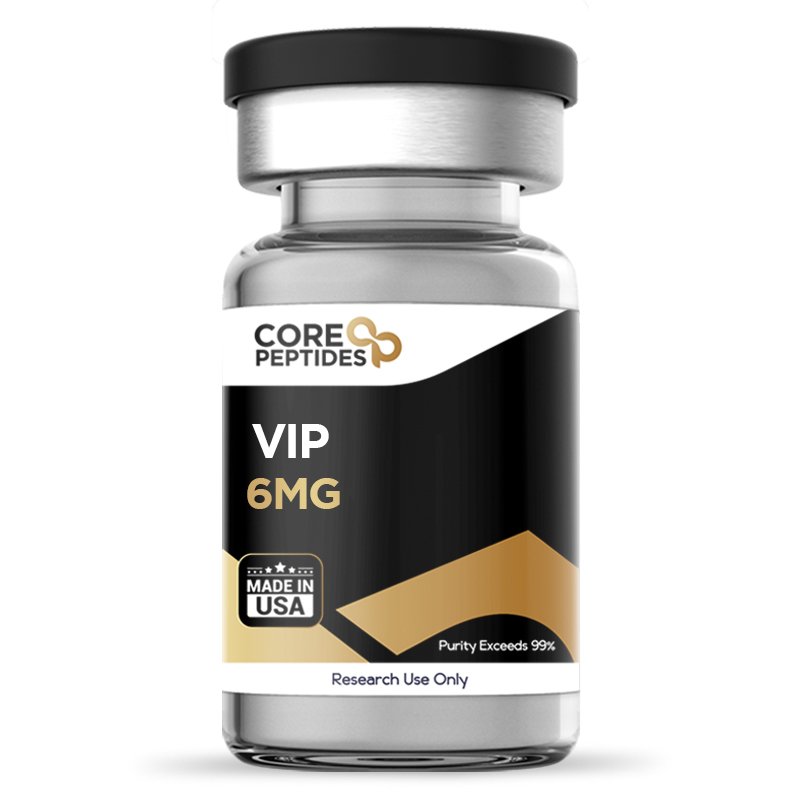
VIP Peptide
Vasoactive Intestinal Peptide, or VIP, is a short peptide hormone composed of 28 amino acid residues found naturally in both peripheral and central nervous systems.(1) Researchers speculate that the apparently wide distribution of the peptide indicates its pleiotropic potential as a neurotransmitter, vasodilator, and possibly as an immune regulator and secretagogue.(1)
VIP has a vast spectrum of potential, including but not limited to neuromodulation and neurotransmission functions. Given the wide range of its possible relevance in various research contexts, VIP has been of immense interest among researchers for further exploration.(2)(3)
Overview
Scientists posit that the VIP peptide binds with three types of G protein-coupled receptors, namely VPAC1, VPAC2, and PAC1. Upon binding with these receptors, the pathway associated with adenylate cyclase (key regulatory enzyme) may be activated, possibly resulting in biological activity.(4) The primary difference between the three receptors is their localization. Research indicates that VPAC1 is mainly expressed in the brain and peripheral areas, such as the liver, lungs, intestine, and immune cells, whereas VPAC2 is expressed in the central nervous system and other peripheral areas such as the pancreas, heart, kidney, skeletal muscles, gastrointestinal and reproductive tract, and PAC1 is predominant in the brain and adrenal region.(4) Owing to the wide distribution of the receptors, researchers suggest that VIP and receptor binding might affect different targets in the central and peripheral system (depending on receptor location).
Chemical Makeup
Molecular Formula: C147H237N43O43S
Molecular Weight: 3326.8 g/mol
Other Known Titles: PHM27, Vasoactive intestinal polypeptide
Research and Clinical Studies
VIP Peptide and Inflammation
Research(5) has suggested that VIP, which appears to be produced directly by immune cells themselves, exhibits various potential immunological actions to maintain an equilibrium of the immune system. Several studies have suggested that VIP possesses anti-inflammatory potential in both innate (hereditary) immunity and adaptive (acquired) immunity. In innate immunity, VIP has been posited to inhibit the synthesis of inflammatory chemicals such as cytokines and chemokines, while in adaptive immunity, VIP may inhibit responses of the inflammatory Th1-type cells and may promote Th2-type cell responses. Due to its potential to reduce Th1-type inflammatory cell actions, VIP may improve intestinal immunity and decrease inflammation.(6)
One study explored the potential interactions between VIP and inflammation within the context of necrotizing enterocolitis (NEC), primarily using murine models. VIP, lauded for its potential anti-inflammatory characteristics, might regulate intestinal epithelial barrier integrity and homeostasis. The research posits that the decreased expression of VIP-ergic neurons in the NEC-affected ileum may be linked to heightened inflammation and compromised barrier function. In this experimental setup, NEC was induced in neonatal C57BL/6 murine models between postnatal days 5 and 9. The study measured NEC severity, intestinal inflammation markers like IL-6 and TNFα, and the expression of tight junction proteins such as Claudin-3. The results indicated that VIP mRNA expression and immunoactivity appeared substantially reduced in NEC models compared to controls. Exogenous VIP apparently reduced NEC severity and decreased the levels of proinflammatory cytokines IL-6 and TNFα in the NEC + VIP group compared to the NEC group alone. This suggests that VIP might have a role in moderating inflammatory responses. Furthermore, the research suggested that VIP might help preserve tight junction integrity. Specifically, Claudin-3 expression, considered crucial for tight junction function and intestinal barrier integrity, was enhanced in the NEC + VIP group relative to the NEC group alone. This finding implies a potential mechanism by which VIP might maintain barrier function amidst inflammatory conditions.
VIP Peptide and the Blood Brain Barrier
The blood-brain barrier (BBB) and blood-spinal barrier (BSB) are considered a crucial part of the nervous system, providing cellular protection to the tissues and blood vessels of the central nervous system. The blood-brain barrier appears to filter everything from oxygen to nutrition factors, which may potentially enter these neurological vessels and affect immune function. Compromise of the blood-brain barrier may lead to severe physiological impacts. Research has suggested that VIP may exhibit some neuroprotective potential, which might support proper maintenance of the blood-brain barrier.(9) VIP is possibly involved in several functions, such as neurotransmission, vasodilation, and immune modulation. By activating adenylate cyclase (AC), VIP may play a pivotal role in the production of cyclic adenosine monophosphate (cAMP), a regulator of immune responses, including those involving regulatory T cells (Tregs). The disruption of these functions due to autoimmune reactions against VIP or its receptors might potentially lead to increased permeability of the BBB and BSB, commonly referred to as “leakiness,” which may facilitate further autoimmune events. This may result in exacerbated neuroinflammatory and neurodegenerative processes. The Virchow-Robin spaces (VRS), perivascular areas surrounding small vessels in the central nervous system, are particularly noted for their contributions to the integrity of the BBB and BSB. These spaces may contain receptors for VIP and are involved in modulating immune responses. Autoimmune responses targeting these receptors may impair the function of the BBB and BSB, hence the potential role of VIP in their preservation. This is currently under investigation in several experimental models of neurodegeneration.(10)(11)
VIP Peptide and Cardiac Fibrosis
The pathophysiology of cardiac fibrosis is considered to have a high association with angiotensinogen receptors and angiotensinogen converting enzymes (ACE), both of which may lead to vascular inflammation. Research(12) has suggested that VIP peptide may promote some reduction in these angiotensinogen expressions – possibly similar in action to ACE inhibitor compounds. As a result, VIP may mitigate cardiac fibrosis and possibly reverse heart muscle scarring. This is also posited based on observations that lower VIP concentrations correspond with increased fibrosis and are nearly undetectable in end-stage cardiomyopathy. To probe this association further, the study experimented with VIP introduced to murine models on a high-salt diet and assessed changes in myocardial VIP levels, fibrosis quantification via histomorphometry, and the expression of pro-fibrotic mediators through quantitative rt-PCR. Findings suggested that VIP-exposed murine models may have exhibited significantly higher myocardial VIP levels than controls, alongside notably lower fibrosis metrics. Not all pro-fibrotic mediators were impacted by VIP infusion; that stated, significant reductions in angiotensinogen (Agt) and angiotensin receptor type 1a (AT1a) mRNA expression were noted, indicating a potential downregulation of the renin-angiotensin system—a key pathway implicated in fibrotic processes. The study cautiously infers that the observed decrease in myocardial fibrosis may be attributed, at least in part, to the downregulation of key components of the renin-angiotensin system, moderated by elevated VIP levels. This hypothesis aligns with the noted decreases in Agt and AT1a mRNA expression post-VIP exposure. However, the mechanisms through which VIP may exert these actions remain uncertain and warrant further investigation. Moreover, while VIP appeared to influence some pro-fibrotic mediators, it did not appear to alter others, such as TGFβ, TNFα, CTGF, and NFκB, suggesting that the anti-fibrotic actions of VIP might be selective or mediated through alternative pathways not examined in this study.
VIP and Behavioral Responses in Animals
Studies(13) have suggested that VIP neurons may be activated when animals process behavioral responses. Activating the VIP neurons in the hypothalamus region may also trigger the secretion of prolactin hormones, which is considered the primary trigger of behaviors such as affiliation, gregariousness, pair bonding, and aggression. More specifically, it appears that VIP and its associated VPAC receptors, which are distributed across both hypothalamic and extrahypothalamic regions, may ultimately result in its potential on various behavioral and reproductive functions. Further, VIP’s influence on prolactin (PRL) secretion is linked to various reproductive behaviors across different experimental models, as changes in VIP levels within the hypothalamus closely mirror fluctuations in plasma PRL levels corresponding to different reproductive stages. This suggests that VIP might have a role in modulating behaviors preparatory to offspring care. Moreover, VIP’s role in circadian rhythm regulation, particularly through its interactions in the suprachiasmatic nucleus (SCN), where it modulates the activity of GABAergic cells, highlights its importance in the synchronization of biological rhythms. These include the potential timing of ovulation and responses to photoperiod changes, which might be crucial for understanding seasonal reproduction patterns in both mammals and birds. The study also delves into VIP’s roles in social behavior networks, indicating that VIP might influence behaviors such as aggression and pair bonding through itsinteractions with other neuropeptides, including oxytocin and vasopressin, in these networks. Intriguingly, the study posits that VIP’s interaction with these neuropeptides might modulate responses to social and environmental stressors, potentially affecting an animal’s social dynamics and behaviors. In terms of aggression, VIP is thought to potentially alter aggressive behaviors, as indicated in studies where manipulation of VIP levels in the hypothalamic regions appeared to have influenced aggressive responses in certain avian species. This action may also be mediated through the interactions of VIP with other signaling molecules within key areas of the brain known to regulate aggression. The full role of VIP in behavioral responses is still under exploration.
VIP peptide is available for research and laboratory purposes only. Please review and adhere to our Terms and Conditions before ordering.
References:
Delgado, M., & Ganea, D. (2013). Vasoactive intestinal peptide: a neuropeptide with pleiotropic immune functions. Amino acids, 45(1), 25–39. https://www.ncbi.nlm.nih.gov/pmc/articles/PMC3883350/
Iwasaki, M., Akiba, Y., & Kaunitz, J. D. (2019). Recent advances in vasoactive intestinal peptide physiology and pathophysiology: focus on the gastrointestinal system. F1000Research, 8, F1000 Faculty Rev-1629. https://www.ncbi.nlm.nih.gov/pmc/articles/PMC6743256/
Welsh, D. K., Takahashi, J. S., & Kay, S. A. (2010). Suprachiasmatic nucleus: cell autonomy and network properties. Annual review of physiology, 72, 551–577. https://www.ncbi.nlm.nih.gov/pmc/articles/PMC3758475/
Vosko, A. M., Schroeder, A., Loh, D. H., & Colwell, C. S. (2007). Vasoactive intestinal peptide and the mammalian circadian system. General and comparative endocrinology, 152(2-3), 165–175. https://www.ncbi.nlm.nih.gov/pmc/articles/PMC1994114/
Gonzalez-Rey E, Delgado M. Role of vasoactive intestinal peptide in inflammation and autoimmunity. Curr Opin Investig Drugs. 2005 Nov;6(11):1116-23. https://pubmed.ncbi.nlm.nih.gov/16312132/
Seo S, Miyake H, Alganabi M, Janssen Lok M, O’Connell JS, Lee C, Li B, Pierro A. Vasoactive intestinal peptide decreases inflammation and tight junction disruption in experimental necrotizing enterocolitis. https://pubmed.ncbi.nlm.nih.gov/31668399/
Chorny A, Gonzalez-Rey E, Delgado M. Regulation of dendritic cell differentiation by vasoactive intestinal peptide: therapeutic applications on autoimmunity and transplantation. Ann N Y Acad Sci. 2006 Nov;1088:187-94. https://pubmed.ncbi.nlm.nih.gov/17192565/
Chorny, A., Gonzalez-Rey, E., Fernandez-Martin, A., Pozo, D., Ganea, D., & Delgado, M. (2005). Vasoactive intestinal peptide induces regulatory dendritic cells with therapeutic effects on autoimmune disorders. Proceedings of the National Academy of Sciences of the United States of America, 102(38), 13562–13567. https://www.ncbi.nlm.nih.gov/pmc/articles/PMC1224633/
Staines DR, Brenu EW, Marshall-Gradisnik S. Postulated vasoactive neuropeptide immunopathology affecting the blood-brain/blood-spinal barrier in certain neuropsychiatric fatigue-related conditions: A role for phosphodiesterase inhibitors in treatment? Neuropsychiatr Dis Treat. 2009;5:81-9. Epub 2009 Apr 8. PMID: 19557103; PMCID: PMC2695238. https://pubmed.ncbi.nlm.nih.gov/19557103/
Mosley RL, Lu Y, Olson KE, Machhi J, Yan W, Namminga KL, Smith JR, Shandler SJ, Gendelman HE. A Synthetic Agonist to Vasoactive Intestinal Peptide Receptor-2 Induces Regulatory T Cell Neuroprotective Activities in Models of Parkinson’s Disease. Front Cell Neurosci. 2019 Sep 18;13:421. https://pubmed.ncbi.nlm.nih.gov/31619964/
Solés-Tarrés, I., Cabezas-Llobet, N., Vaudry, D., & Xifró, X. (2020). Protective Effects of Pituitary Adenylate Cyclase-Activating Polypeptide and Vasoactive Intestinal Peptide Against Cognitive Decline in Neurodegenerative Diseases. Frontiers in cellular neuroscience, 14, 221. https://www.ncbi.nlm.nih.gov/pmc/articles/PMC7380167/
Karen A. Duggan, George Hodge, Juchuan Chen, Tegan Hunter, Vasoactive intestinal peptide infusion reverses existing myocardial fibrosis in the rat, European Journal of Pharmacology, Volume 862, 2019, 172629, ISSN 0014-2999. https://www.sciencedirect.com/science/article/pii/S0014299919305813
Kingsbury MA. New perspectives on vasoactive intestinal polypeptide as a widespread modulator of social behavior. Curr Opin Behav Sci. 2015 Dec 1;6:139-147. https://pubmed.ncbi.nlm.nih.gov/26858968/
Domschke, S., Domschke, W., Bloom, S. R., Mitznegg, P., Mitchell, S. J., Lux, G., & Strunz, U. (1978). Vasoactive intestinal peptide in man: pharmacokinetics, metabolic and circulatory effects. Gut, 19(11), 1049–1053. https://www.ncbi.nlm.nih.gov/pmc/articles/PMC1412244/
Be the first to review “VIP (6mg)”
Related products


PEPTIDES


PEPTIDES
Reviews
There are no reviews yet.