
Blog
Sermorelin: Potential Interactions with Different Hormone-Producing Cells
May
Sermorelin Peptide: Mechanisms of Action, hGH Synthesis, and Endocrine Signaling Research
What Is Sermorelin Peptide and How Does It Interact With Growth Hormone Pathways?
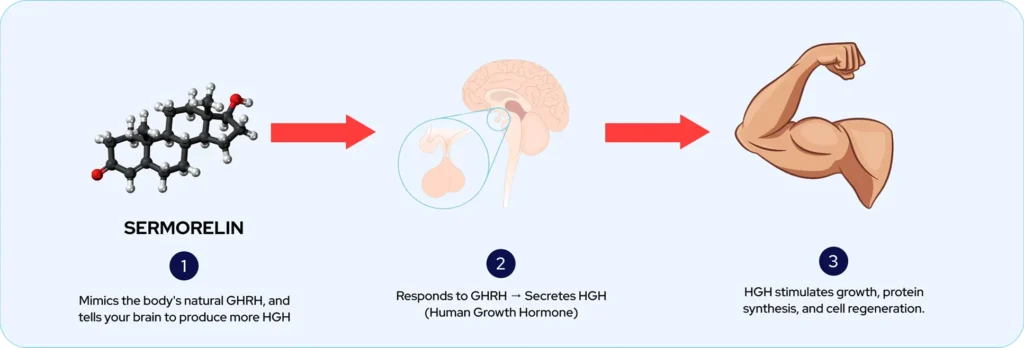
Sermorelin is a synthetic research peptide commonly studied as the shortest functional analog of endogenous growth hormone–releasing hormone (GHRH). Naturally occurring GHRH consists of 44 amino acids and is widely considered the primary hypothalamic signal responsible for stimulating the synthesis and release of human growth hormone (hGH) from anterior pituitary cells . Sermorelin is a synthetic 29-amino acid peptide analog of the naturally occurring growth hormone-releasing hormone (GHRH 1-29), specifically designed to stimulate endogenous growth hormone (GH) production from the anterior pituitary gland. Originally developed as the biologically active N-terminal fragment of human GHRH, sermorelin represents a physiologically appropriate approach to growth hormone optimization that preserves natural pulsatile secretion patterns and regulatory feedback mechanisms.
This peptide has gained considerable attention in endocrinology and age management medicine due to its demonstrated efficacy in treating growth hormone deficiency while maintaining physiological safety through preservation of the body’s natural regulatory systems. Sermorelin exhibits excellent bioavailability via subcutaneous administration and stimulates growth hormone release without disrupting natural circadian rhythms or feedback inhibition, making it unique among growth hormone-related therapeutics
These anterior pituitary cells express GHRH receptors, which play a central role in initiating intracellular signaling pathways linked to hGH production. Despite containing only the first 29 amino acids of the full GHRH sequence, Sermorelin appears sufficient in laboratory models to activate these receptors and trigger downstream signaling events.
The peptide also features an amidated C-terminal structure, which is believed to contribute to molecular stability and improve receptor interaction efficiency. Because of this, Sermorelin continues to be widely explored in research involving growth hormone signaling, pituitary cell function, and endocrine system regulation.
Sermorelin Mechanism of Action in Pituitary Cells
How Sermorelin Activates GHRH Receptors
Research suggests that Sermorelin binds to the extracellular domain of GHRH receptors located on anterior pituitary cells. This interaction appears to stabilize the receptor in an active conformation, allowing it to couple with Gαs proteins.
Gαs proteins function as membrane-associated signaling switches. Once activated, they transmit signals from the receptor to intracellular enzymes responsible for amplifying the biological response.
cAMP Signaling and Protein Kinase A Activation
Following Gαs activation, adenylyl cyclase activity may increase, leading to elevated levels of cyclic AMP (cAMP). This molecule acts as a secondary messenger, distributing the signal throughout the cell.
Increased cAMP levels may activate protein kinase A (PKA), an enzyme responsible for phosphorylating target proteins. This phosphorylation cascade plays a key role in regulating gene expression, protein activity, and hormone synthesis within pituitary cells.
Calcium Signaling and hGH Secretion Dynamics
In pituitary-derived experimental models, Sermorelin signaling appears to influence membrane excitability and calcium influx.
Activation of GHRH receptors may lead to:
- depolarization of the plasma membrane
- opening of voltage-gated calcium (Ca²⁺) channels
- increased intracellular calcium levels
Calcium acts as a primary trigger for regulated exocytosis, enabling the release of hGH from intracellular vesicles. This process works alongside the cAMP/PKA pathway, forming a coordinated system that regulates both hormone synthesis and secretion.
Sermorelin and Human Growth Hormone (hGH) Synthesis
Observed Effects on hGH Production in Research Models
Experimental studies examining Sermorelin exposure have reported measurable increases in hGH secretion from pituitary cells.
In controlled laboratory settings:
- hGH levels have been observed to increase approximately twofold
- total hormone output (AUC) shows significant elevation
- peak secretion levels may remain relatively stable
These findings suggest that Sermorelin may enhance overall hormone release rather than dramatically altering peak amplitude.
Temporal Nature of hGH Release
One consistent observation across studies is the time-dependent nature of Sermorelin-induced hGH release.
- The most pronounced increase occurs within the first two hours
- After this phase, hormone levels gradually return toward baseline
- Natural pulsatile secretion patterns remain largely intact
This indicates that Sermorelin may introduce an additional signaling pulse without disrupting the body’s underlying rhythm of growth hormone release.
IGF-1 Response and Downstream Anabolic Signaling
How Sermorelin Influences IGF-1 Levels
Because hGH acts upstream of insulin-like growth factor 1 (IGF-1), researchers often examine IGF-1 as a secondary marker of peptide activity.
In experimental observations:
- IGF-1 levels have been reported to increase by approximately 27–28%
- This increase follows elevated hGH output
- The relationship between hGH and IGF-1 is not always strictly linear
These findings support the role of Sermorelin in influencing growth hormone–dependent signaling pathways.
Role of IGF-1 in Cellular and Endocrine Systems
IGF-1 is widely studied for its involvement in:
- cellular growth and proliferation
- protein synthesis pathways
- tissue regeneration
- endocrine and paracrine signaling
The increase in IGF-1 following Sermorelin exposure highlights its importance as a downstream mediator in growth hormone research.
Sermorelin and Testosterone Pathway Research
Indirect Influence Through IGF-1 Signaling
Some research has explored how increased IGF-1 levels may affect steroidogenic tissues, particularly Leydig cells in the testes.
Leydig cells are responsible for testosterone production and respond primarily to luteinizing hormone (LH) or human chorionic gonadotropin (hCG).
Leydig Cell Responsiveness and Hormone Binding
Experimental findings suggest that elevated IGF-1 levels may:
- increase LH/hCG receptor binding capacity
- enhance Leydig cell responsiveness to stimulation
- amplify acute testosterone output under experimental conditions
In one study:
- hCG binding increased from ~2.5 to ~5.6 fmol/g
- testosterone output increased significantly after stimulation
These findings suggest that IGF-1 may improve the responsiveness of steroidogenic cells, rather than directly driving testosterone production.
Integration of Endocrine Signaling Pathways
Multi-Step Hormonal Signaling Cascade
Sermorelin research highlights the complexity of endocrine signaling through a multi-step process:
- GHRH receptor activation
- Gαs protein signaling
- cAMP production and PKA activation
- Calcium influx and membrane depolarization
- hGH secretion from pituitary cells
- IGF-1 production in peripheral tissues
- Secondary endocrine effects (e.g., Leydig cell responsiveness)
Each step represents a key point of investigation in peptide-based research.
Why Sermorelin Is Considered a Regulatory Peptide
Rather than directly replacing hormones, Sermorelin functions by stimulating upstream signaling pathways.
Its research relevance lies in its ability to:
- activate natural hormone production mechanisms
- preserve physiological pulsatility
- influence multiple downstream systems
- provide insight into endocrine regulation
Final Thoughts on Sermorelin Peptide Research
Sermorelin remains one of the most studied peptides in growth hormone research due to its ability to replicate key aspects of endogenous GHRH activity.
Laboratory investigations continue to explore its role in:
- GHRH receptor activation
- intracellular signaling cascades
- hGH synthesis and secretion
- IGF-1-mediated pathways
- broader endocrine system interactions
Its effects are characterized by targeted receptor activation, transient hormone release, and preserved biological rhythms, making it a valuable compound for studying how peptide signaling influences complex hormonal networks.
